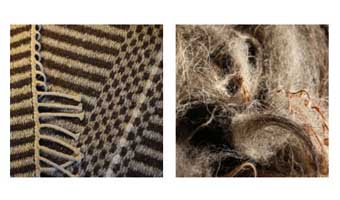
The fibrous parts of plants, mostly in the leaves, stems and roots, were used unprocessed as
thatch, clothing and twine before agriculture began here.
Agriculture provided bulk sources of fibre with which the early farming people were able to make
cloth for clothing and for carrying things.
Flax has been the only major fibre crop here, grown to produce linen, but is no longer farmed
commercially. Hemp and nettle have also been grown occasionally for craft-work and minor commercial
production.
The main fibre products produced locally now come, not from crops, but from plantation forestry
and animals, notably sheep and camellids.
Most of the world’s plant fibre crops are grown in warmer places than the north east Atlantic.
Plant fibres are now imported as raw or finished product for wide use in home and industry as
clothing (e.g. cotton, denim, linen, silk, wool), floorcovering (carpet, matting, lino), insulation,
particle board, sacking, canvas, rope and twine.
The greatest effect of plant fibres on industry here has been through the import and processing of
cotton and jute, around which huge industries developed in central and eastern Scotland in the 1700s
and 1800s.
Plant fibres such as jute are making a comeback in a range of innovative products, made locally
from imported raw materials.
Fibre crops have had only small lasting effects on the plants and ecology of the croplands - relic
plants of the flax industry are very rare, and while nettles are still very common, it is not
because they were once used for cloth-making.